
Choosing Between Injection Moulding and 3D Printing: A Practical Manufacturing Comparison
As additive manufacturing technologies continue to mature, product teams increasingly face a key question early in the development process: should this part be injection moulded or 3D printed?
While both methods can produce high-quality plastic components, they differ significantly in terms of cost structure, scalability, material properties, and design flexibility. Choosing the right approach requires more than just comparing price per unit - it involves understanding your product’s function, production volume, timeline, and long-term goals.
This article offers a practical, side-by-side comparison of injection moulding and 3D printing to help engineers and decision-makers select the most appropriate process for their needs.
Understanding the Fundamentals
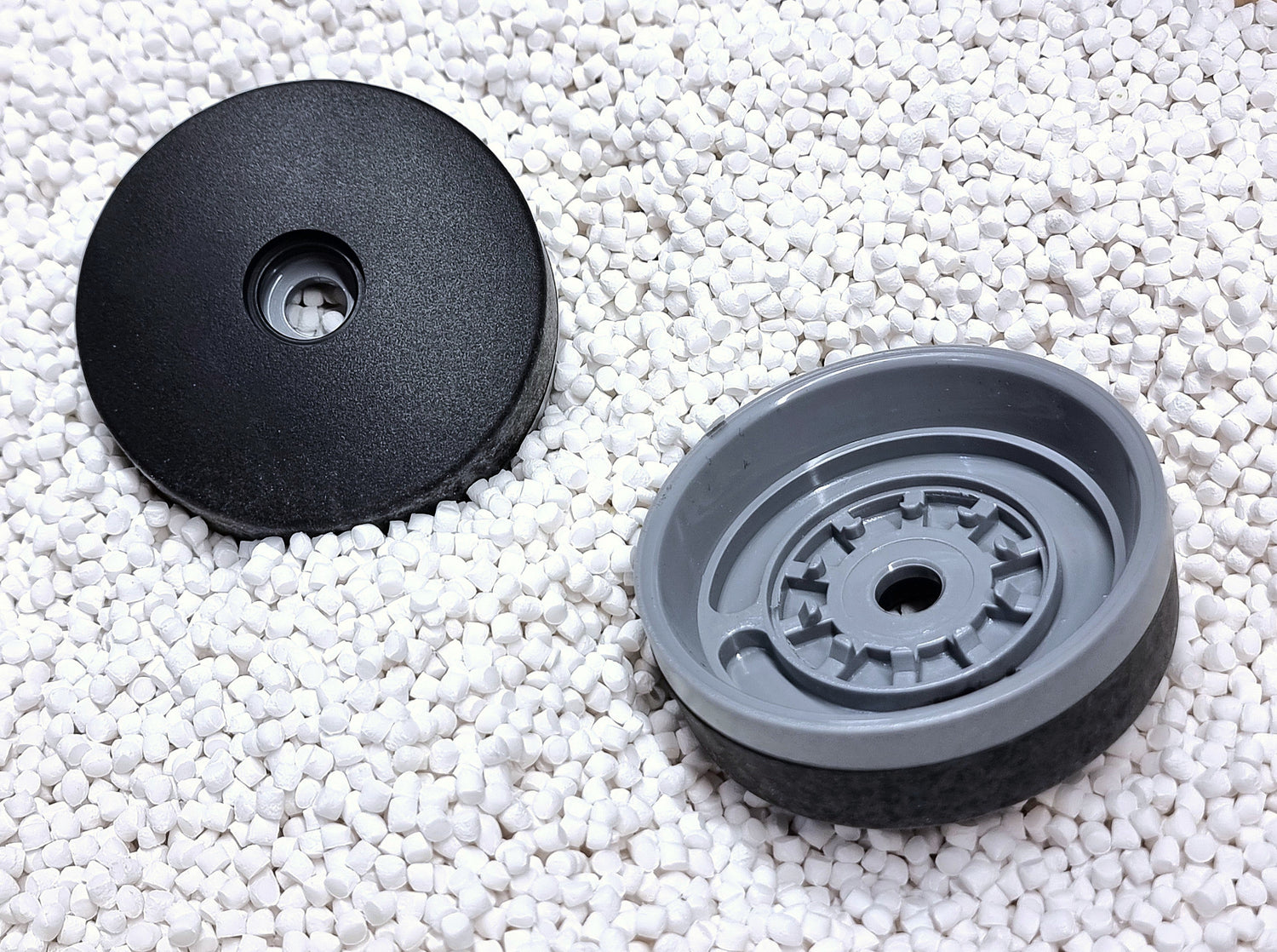
Injection moulding is a long-established manufacturing process that involves injecting molten plastic into a hardened steel or aluminium mould. Once cooled, the part is ejected and the cycle repeats, typically in under a minute. This method is exceptionally efficient for producing high volumes of identical parts with excellent consistency, surface finish, and dimensional stability.
3D printing, by contrast, builds parts additively, layer by layer, directly from a digital model. Various technologies exist within this category - FDM, SLA, SLS, MJF, and more - each offering different combinations of resolution, material compatibility, and mechanical performance. Because there are no moulds involved, the upfront cost is low, and design changes can be made quickly.
Production Volume and Cost Efficiency
The most immediate distinction between the two methods lies in their economic profiles.
Injection moulding requires significant upfront investment in tooling. The cost to produce a single mould can range from several thousand to tens of thousands of pounds, depending on complexity and material. However, once the tool is built, the marginal cost per part is extremely low - often measured in pence for high-volume production. For this reason, injection moulding is ideal for batches in the thousands or millions.
3D printing has no tooling costs, which makes it highly attractive for prototyping, short runs, or customisation. The cost per part, however, remains relatively high and scales linearly with volume. While advances in print speed and automation continue to reduce costs, 3D printing is unlikely to match injection moulding’s efficiency at scale in the near term.
Design Flexibility and Complexity
Where injection moulding excels in scale, 3D printing excels in complexity.
Because 3D printing does not require part-specific tooling, designers can create intricate geometries, internal features, lattice structures, and organic forms that would be impossible or prohibitively expensive to mould. Design changes can be implemented rapidly without the need for new tooling.
Injection moulding, on the other hand, imposes certain constraints. Draft angles, uniform wall thickness, and the avoidance of undercuts are often necessary to ensure proper mould release and cooling. While complex moulds with side actions or collapsible cores can accommodate more challenging designs, they add cost and lead time.
Material Properties and Performance
Injection moulding supports a wide range of engineering-grade thermoplastics, including filled and reinforced variants with high strength, thermal resistance, and chemical stability. Parts produced via moulding tend to have superior mechanical properties and surface finishes, and they are suitable for high-stress or mission-critical applications.
3D printing materials have improved dramatically in recent years, especially with technologies like SLS, MJF, and resin-based processes. However, many printed parts still fall short of moulded equivalents in terms of strength, isotropy, and long-term durability. Some materials may be brittle or sensitive to environmental exposure, though there are exceptions, particularly with industrial-grade printers and specialty resins or nylons.
It’s worth noting that post-processing - such as annealing, coating, or infiltration - can significantly enhance the performance of 3D printed parts, but this adds time and cost.
Lead Time and Development Speed
When it comes to rapid iteration and development speed, 3D printing holds a clear advantage.
A digital file can be printed overnight, allowing engineers to test form, fit, and function the next day. This accelerates product development cycles, reduces reliance on theoretical modelling, and enables early validation before committing to tooling.
Injection moulding, by contrast, involves a longer lead time upfront. Tool design, fabrication, and validation typically take several weeks - even for simple parts. However, once the tool is complete, parts can be produced at extremely high speed and consistency.
For this reason, a hybrid approach is often used: 3D printing for initial validation and small-batch testing, followed by injection moulding for production.
Surface Finish and Aesthetics
Injection moulded parts typically exhibit high-quality surface finishes straight out of the mould. Textures, gloss levels, and fine detail can be controlled via the tooling surface, allowing for consumer-ready parts with no post-processing.
3D printed parts often require finishing steps such as sanding, polishing, dyeing, or coating to achieve a comparable appearance. While some industrial printers can produce near-mould-quality finishes, this is highly dependent on material and technology.
Sustainability and Waste
Injection moulding is relatively efficient in material usage for high volumes, but waste is generated through sprues, runners, and start-up scrap - though much of this can be reground and reused. The energy cost per part is low once the process is running at scale.
3D printing generates less tooling waste and enables on-demand production, which can reduce overproduction and inventory. However, some print technologies, particularly powder- or resin-based methods, produce unusable excess material or require energy-intensive post-processing. Sustainability varies by printer, material, and recycling capability.
Conclusion: Choosing the Right Process
The decision between injection moulding and 3D printing is rarely straightforward. It depends on a variety of factors; production volume, part complexity, performance requirements, development timeline, and budget constraints.
For low to medium volumes, prototypes, or highly customised parts, 3D printing offers speed, flexibility, and design freedom. For high-volume production where unit cost, repeatability, and material performance are paramount, injection moulding remains the gold standard.
In many cases, the two technologies are not competitors but complements. An effective manufacturing strategy may involve both - using 3D printing for early-stage development and validation, followed by injection moulding to scale up for market.
Need help deciding which process suits your product?
Our engineering team offers consultation services to evaluate your part, review your design goals, and recommend the most effective manufacturing path - balancing speed, performance, and cost.
0 comments